Family History Site
An encrypted family history going back 16 generations, with an interactive tree, a map of every journey, and a grade on every fact. AI did all the research, inside a system I built to keep it right.
Live demo
The real site holds my family’s real history, encrypted behind a password. The demo below is the same site running on a made-up family, so you can try every feature without seeing anyone’s real data.
The demo opens in a new tab.
The real tree, in numbers
LiveNumbers as of
- 16generations, back to about 1500
- 398people, 116 with full biographies
- 584online sources, every one saved in a private archive
- 12countries, with 205 places on the map
AI agents at work
I rebuilt my family’s old genealogy website into a private, interactive family history. It traces my father’s line back 16 generations, to a man on a 1544 tax roll in Alsace. Everything personal is encrypted and kept behind a password, so only family can read it.
I had AI do all of the research. Agents searched parish registers, censuses, passenger lists, and old newspapers on both sides of the Atlantic, and the cards now carry 1,016 citations to 584 online sources. When a record wasn’t online, AI wrote to genealogists and record keepers and worked their replies onto the cards. Since 7 October 2026, agents have swept the tree one generation at a time, oldest first, for every child of every man in the line, which is where most of its recent growth comes from.
Every source is saved in a separate private archive that keeps a copy of each page, checks them again every month, falls back to the Internet Archive when a site refuses, and holds hand copies of records behind logins, so the evidence survives even if a website disappears. Every photo, scan, letter, and written account a relative sends is kept there too, exactly as received.
How it stays right
Getting AI to do this reliably took far more than a few prompts. Left alone, agents wrote, struck, and put back the same facts, one working from an old copy could undo a week of findings, and later passes even reversed my own decisions. So I built a system around them, and I make the calls they can’t.
- SourceA record found online or sent by an archive
- Saved copyKept in the private archive
- Change with proofEach edit quotes the saved copy
- ChecksCode confirms the proof and runs the tests
- Live siteChecked again once it’s live
One door, with proof
Every edit goes through one tool that records its reason and proof, and a citation must quote the saved copy of its source, which code checks is really there. Tests cover privacy, matching English and French, and each biography against its sources. Undoing a change takes a written reason, and the full history is kept.
No one checks their own work
A second agent rereads each record from the image alone, and a third compares every name, date, place, and link with the record before a change is saved; mismatches come to me. Auditors checked every card but their own and could only propose fixes, and striking a true citation counted as much as keeping a false one.
I set the rules
Inside the family line, agents add only what the records prove, and sources rank in my order: registers, then death certificates and newspapers, censuses, family letters, and other people’s trees last. A register holds hundreds of settled questions; reopening one takes new evidence, and only I can reopen my own calls.
The calls I make
The calls the AI can’t make come to me as short questions on cards, and I answer Yes, No, or in my own words.
Why it runs in the cloud
Until October 2026, the agents ran on my own computer: a run stopped whenever it slept, every change waited for me to publish it, and the working files lived on that one machine. Now each session starts on a fresh cloud machine, sets itself up from private GitHub repositories, and saves its work back before it ends.
- Card or scheduleA tap on a card, or a scheduled run
- Cloud sessionA fresh machine for every run
- QueueChanges wait; nothing goes live directly
- AirlockA separate checker the AI can’t reach
- Live siteChecked again once it’s live
An airlock the AI can’t reach
Every change has to pass a separate checker that no AI session can reach or alter. Only encrypted family data gets through, and anything it refuses stays out.
Security built in
Personal data is encrypted before anything is published, no AI session can publish on its own, and the site’s password never appears in the AI’s work.
I still make every critical call on a card; publishing is what became automatic.
How sure each link is
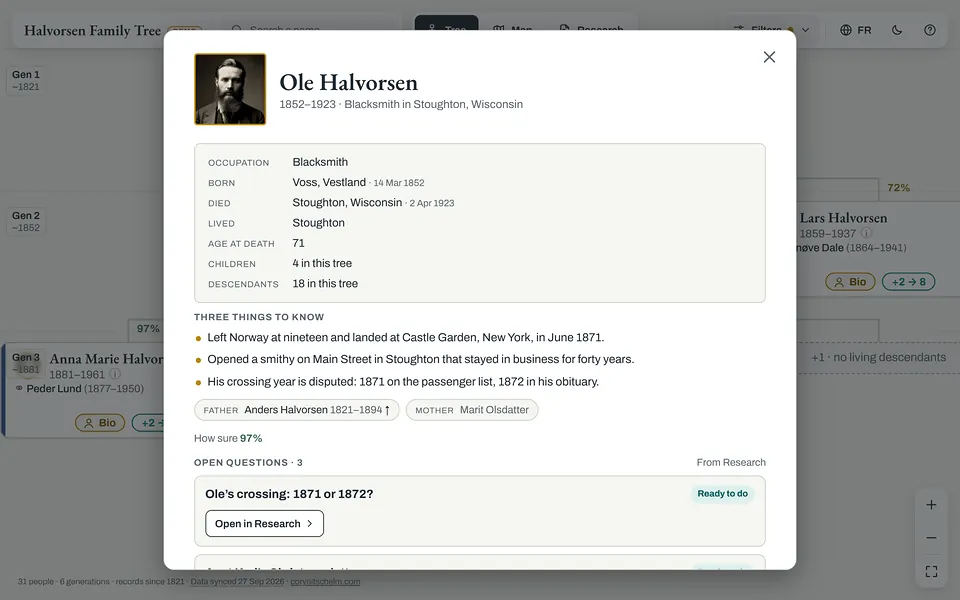
Every parent-child link carries a percent, scored with a written rubric: a record read in the original scores high, and a link that rests only on someone else’s compiled tree scores low. Relatives see the figure on the line and in the bio. Only I see the reasons.
Where a relative confirmed a link firsthand, I can set the figure myself, and the site marks it as mine, beside the records’ own figure. The low figures drive the research: each points at the record that would settle it. Right now, 281 of 314 family links are 90% sure or better.
What I built
- An interactive tree with a card for every person and 116 full biographies
- 99 original records and photos shown right on the cards
- Every fact graded as documented, inferred, or approximate, with conflicting sources kept side by side
- A map of every journey: 899 pins in 205 places across 12 countries, drawn without third-party map tiles, with a Play button that shows the family spreading year by year
- A Research view of every open question: 24 investigations and 27 open questions, with their sources, archive visits, and a visit list in priority order for each helper
- Full English and French versions, with every pair the checker flagged read and reconciled (185 items, 32 corrections)
- Accessibility: a keyboard and screen-reader pass, with WCAG 2.2 AA checks on ten phone, tablet, and laptop setups
- Live numbers on this page, straight from the family site: every change that ships there updates them here, after the same checks